

On-Page SEO: The Complete Guide to Ranking Higher in Google
Everything you need to know about optimizing your web pages, from title tags and headers to content structure, internal linking, and E-E-A-T signals.
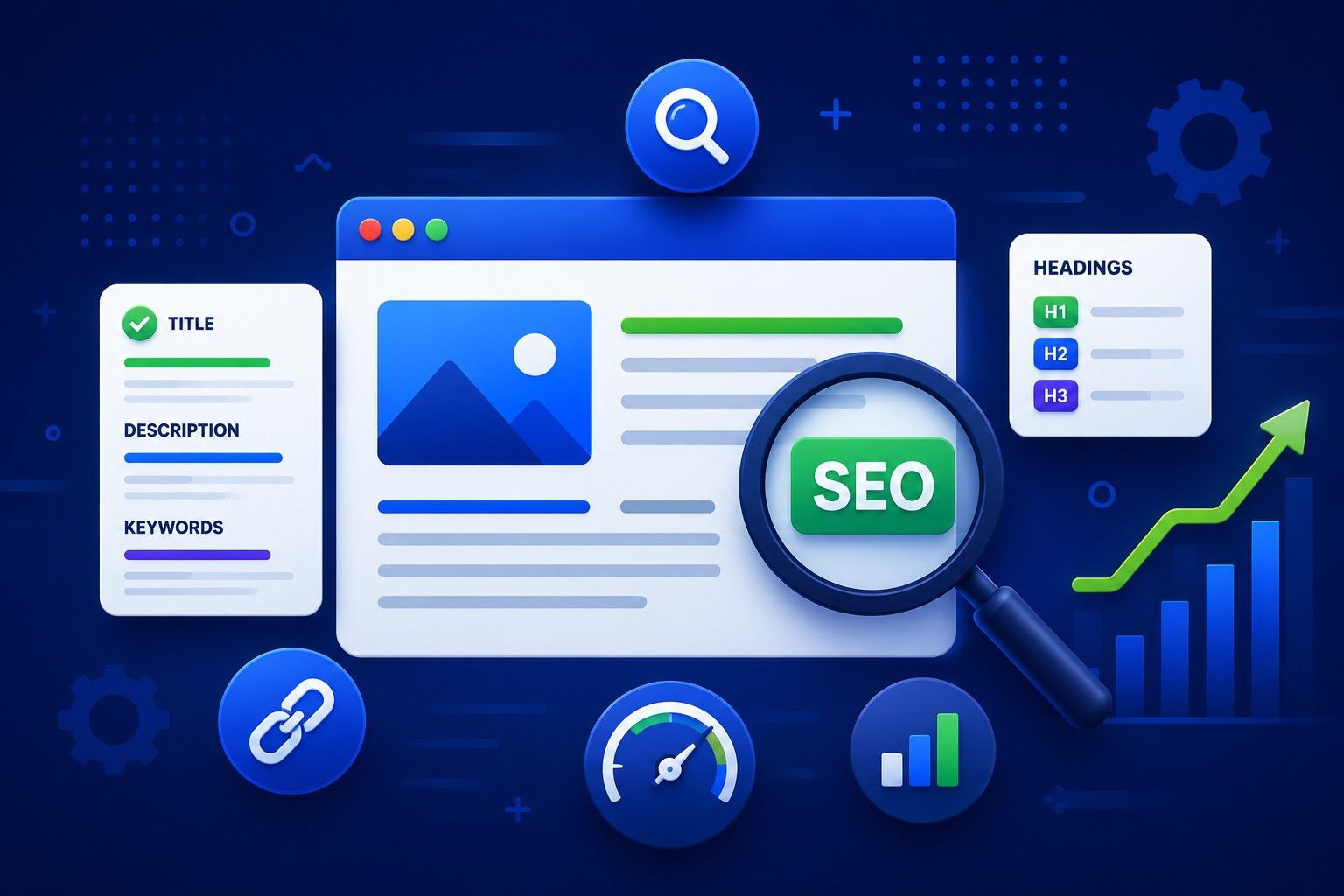
On-page SEO is the practice of optimizing elements within individual web pages, including title tags, meta descriptions, header tags, content, internal links, image alt text, URL slugs, and structured data, to improve search engine rankings and earn more organic traffic. Every on-page signal is within the direct control of the website owner, making it the most actionable part of any SEO strategy.
What Is On-Page SEO?
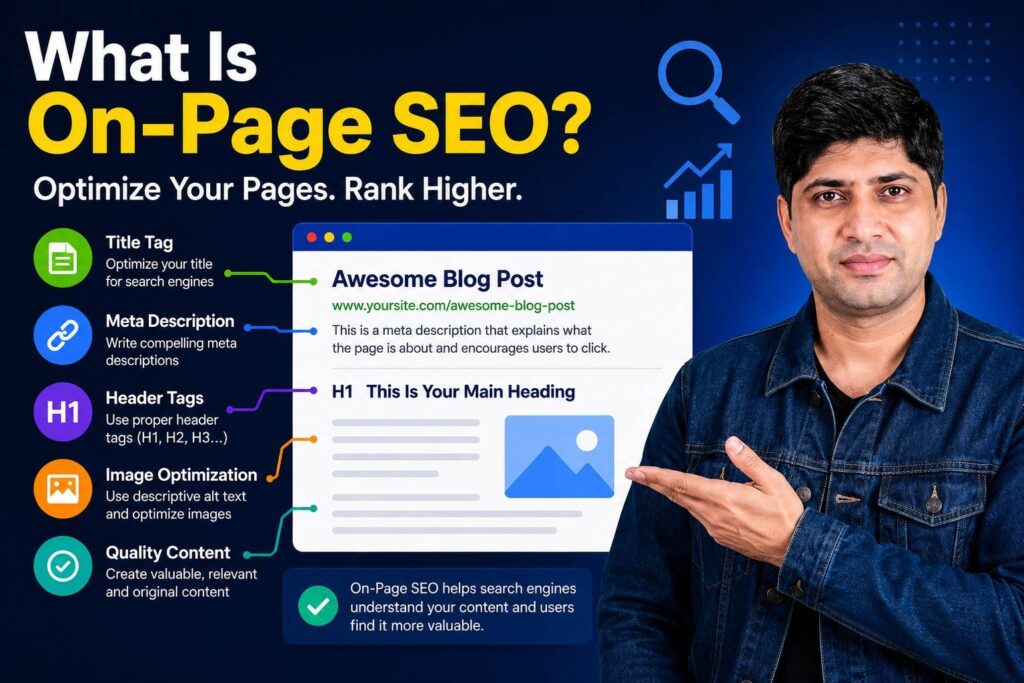
On-page SEO refers to all optimizations applied directly within a web page to help search engines understand it, rank it correctly, and serve it to the right users at the right time. This includes HTML elements such as title tags, header tags, and meta descriptions, as well as the content itself, images, internal links, and structured data markup.
The term “on-page” distinguishes these optimizations from off-page factors like backlinks and technical factors like crawlability. While all three pillars matter, on-page SEO is the foundation. Google must understand a page before it can rank it. No amount of external authority compensates for content that is unclear, shallow, or poorly structured.
Key insight: On-page SEO is the only part of search optimization where you have 100% direct control. You cannot force a backlink to appear or control a server’s rendering speed, but you can optimize every word, tag, link, and structural element on your own pages right now.
The Core On-Page SEO Elements:
Keyword Research
Target high-intent keywords that match real user queries. Blend short-tail volume with long-tail precision to attract traffic that actually converts into customers.
Meta Tag Optimization
Craft compelling title tags and meta descriptions within character limits. Embed primary keywords naturally to boost click-through rates directly from search engine results pages.
Header Tag Structure
Use one keyword-rich H1 per page. Structure H2 to H6 tags to guide both readers and crawlers through your content hierarchy with logical, scannable flow.
Image alt text Optimization
Write descriptive alt text that naturally includes relevant keywords. This improves accessibility for screen readers, boosts image search rankings, and signals contextual relevance to Google.
Internal Linking Strategy
Connect related pages using descriptive anchor text to distribute authority across your site. Strong internal linking improves crawl depth, reduces bounce rates, and strengthens topical relevance.
Content Length and Readability
Match content depth to search intent rather than chasing word counts. Use short paragraphs, clear subheadings, and simple language to keep readers engaged and reduce exit rates.
Canonical Tags
Use canonical tags to consolidate duplicate URLs and protect link equity. Prevent content cannibalization so Google consistently ranks your preferred page for every important target keyword.
URL Structure
Keep URLs short, descriptive, and keyword-focused. Remove stop words, use hyphens between words, and reflect your site structure to improve both crawlability and user trust.
Thin Content and Content Quality Improvement
Identify low-value pages and expand or consolidate them. Add expert insights, supporting data, and practical examples to meet Google’s E-E-A-T standards and improve overall domain authority.
Outbound and External Linking Best Practices
Link to credible, authoritative external sources to strengthen your content’s trustworthiness. Use relevant anchor text, apply nofollow where needed, and always open external links in new tabs.
Schema Markup
Machine-readable JSON-LD code that helps search engines understand your page and makes it eligible for rich results. Schema markup can also improve how AI systems interpret and connect information from your content.
AI Mentions and AI Search Visibility
Structure content with clear facts, entities, and direct answers to get cited in AI-powered search results. Conversational phrasing and schema markup improve visibility across ChatGPT, Gemini, and Perplexity.
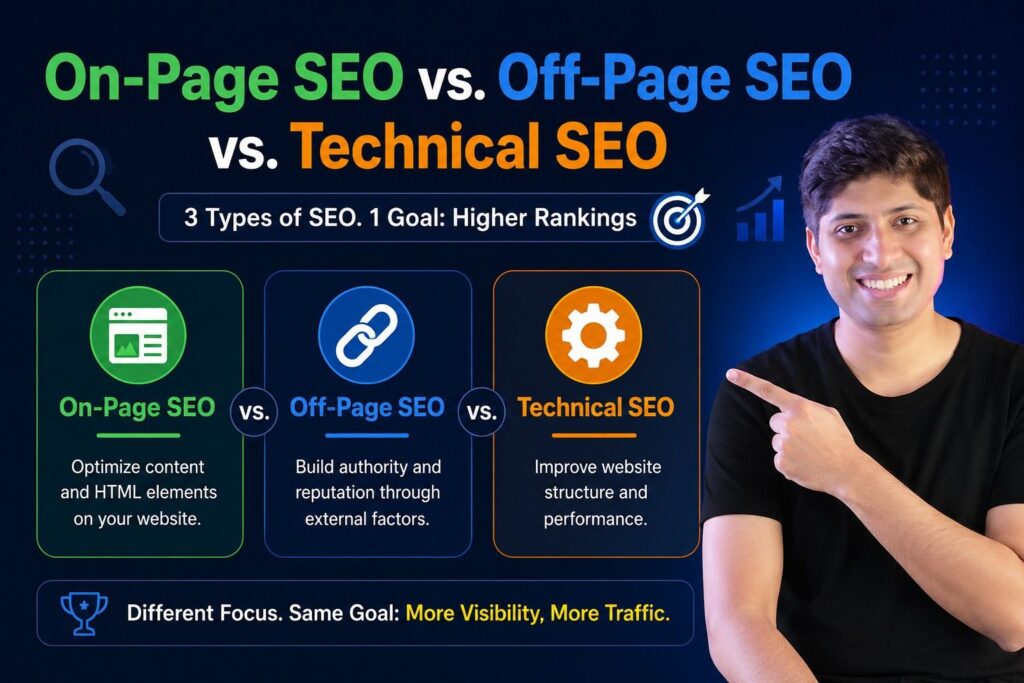
On-Page SEO vs. Off-Page SEO vs. Technical SEO
SEO is built on three interconnected pillars. Knowing the boundary between them prevents you from placing the wrong content on the wrong page, which is one of the most common causes of keyword cannibalization.
On-Page SEO
100% your control
- Title tags and meta descriptions
- H1 to H6 header structure
- Content quality and keywords
- Internal linking
- Image alt text and file names
- URL slugs
- Schema and structured data
- E-E-A-T signals
Technical SEO
Dev and you
- Crawlability and indexing
- Core Web Vitals and speed
- Sitemaps and robots.txt
- Canonical tags
- HTTPS and security
- Mobile rendering
- Log file analysis
Off-Page SEO
Influence only
- Backlink acquisition
- Digital PR and outreach
- Brand and entity mentions
- Social signals
- Guest posting
- NAP citations (local SEO)
- Reviews and ratings
Key insight: On-page SEO is the only part of search optimization where you have 100% direct control. You cannot force a backlink to appear or control a server’s rendering speed, but you can optimize every word, tag, link, and structural element on your own pages right now.
Why On-Page SEO Matters?
Google’s algorithm has evolved considerably, but on-page signals remain foundational and in several ways carry more weight than ever before. Three specific 2025 developments have increased the importance of getting on-page fundamentals right.
AI Overviews and SGE Pull Directly from On-Page Content
Google's AI-powered Search Generative Experience (SGE) and AI Overview snippets extract answers from well-structured, clearly written on-page content. If your page uses vague language, lacks direct answers, or is poorly organized, Google's AI models will skip it and cite a competitor's content instead. Clear heading structure, concise answer paragraphs, and factual specificity all increase AI citation probability.
E-E-A-T Has Become a Hard Ranking Filter
Google's Quality Rater Guidelines now place Experience, Expertise, Authoritativeness, and Trustworthiness at the center of how pages are evaluated. Pages targeting YMYL (Your Money Your Life) topics that lack visible author credentials, original research, proper citations, and transparent sourcing are actively deprioritized in rankings, regardless of their backlink profile.
Zero-Click Search Eligibility Depends on On-Page Structure
Featured snippets, People Also Ask entries, knowledge panels, and AI answer boxes all require specific on-page formatting to be eligible. Question-based H2 and H3 headers followed by concise 40 to 60-word answers, FAQPage schema, and HowTo schema are the structures Google uses to power these zero-click placements.
On-Page SEO in the Age of Generative AI Search
As of 2025, search engines including Google, Bing Copilot, Perplexity AI, and ChatGPT Search actively retrieve and cite web content in their AI-generated answers. Pages that are cited by AI models share common traits: clear entity definitions, factually verifiable statements, direct question-and-answer formatting, and structured data markup.
Generative Engine Optimization (GEO) is the practice of structuring on-page content so that AI systems can extract, quote, and attribute it accurately. A page optimized for GEO will use short declarative sentences, include named entities (people, organizations, statistics, dates), and answer specific questions directly rather than burying the answer deep in paragraphs.
Every content decision on this page, including the Quick Answer box at the top, the FAQ section with accordion schema, and the structured data in the page head, is designed to be parsed and cited by both search engines and AI systems.
Google rewrites roughly 33% of title tags when it detects a mismatch between the title, the H1, and the page content. Keeping all three tightly aligned around the same keyword intent prevents Google from replacing your title with something generic, which reduces both rankings and click-through rate.
Frequently Asked Questions about On-Page SEO
What is the most important on-page SEO element in 2026?
Content quality is the most important on-page SEO element in 2025. Google’s Helpful Content system and E-E-A-T evaluation criteria now actively filter out pages that lack depth, original insight, or expert authorship. The title tag has the highest per-element technical impact on rankings and click-through rate, but shallow or inaccurate content will not sustain rankings regardless of how well every other element is optimized.
What are the 9 core elements of on-page SEO?
The 9 core on-page SEO elements are: title tags, meta descriptions, H1 to H6 header tags, content quality and keyword placement, URL structure and slug optimization, image alt text and file naming, internal linking strategy, schema markup and structured data, and E-E-A-T signals. Each element plays a specific role in how Google reads, understands, and ranks a web page.
How is on-page SEO different from technical SEO?
On-page SEO covers the visible and HTML elements of a page including titles, content, headers, internal links, images, and structured data. Technical SEO covers the underlying site infrastructure including crawlability, indexing, page speed, sitemaps, and server configuration. Technical SEO makes a site accessible to Google. On-page SEO tells Google what each page is about and why it deserves to rank for a specific query.
How long does it take to see results from on-page SEO?
On-page SEO changes can be crawled and indexed within 24 to 72 hours for high-authority sites. Ranking improvements typically follow within 4 to 12 weeks, depending on domain authority, crawl frequency, and the competitiveness of the target keywords. Title tag and meta description changes often show measurable CTR improvement within two to three weeks once Google re-crawls and updates its index.
Does keyword density still matter in 2026?
Keyword density as a hard numerical metric does not matter in 2025. Google’s natural language processing models evaluate topical completeness rather than keyword frequency. What matters is whether the page covers the subject thoroughly using semantically related terms and answers the questions users are actually searching. The primary keyword should appear naturally in the title, H1, opening paragraph, and throughout the body without forced repetition.
What is the difference between on-page SEO and content SEO?
Content SEO is a subset of on-page SEO focused specifically on the written content of a page, including keyword research, topical depth, readability, and E-E-A-T signals. On-page SEO is a broader practice that encompasses content SEO plus HTML elements such as title tags, meta descriptions, header tags, image alt text, internal links, and structured data. Strong content SEO and strong technical on-page SEO are both required for competitive rankings.